
Heramba Journeys™ did not begin with an idea for a retreat. It began with a question that had been following me for years: are there places in this country that still carry the kind of force, memory, and spiritual density that people travel halfway around the world to encounter?
I had spent significant time in India, including years of study and practice that taught me to see pilgrimage differently. A sacred place isn't simply somewhere beautiful, old, or historically important — it's a place where attention changes. Where the usual noise of the mind quiets. Where the line between inner life and outer landscape feels less fixed.
When I first learned about Mato Tipila — known on federal maps as Devils Tower — I felt drawn to it. Not because I had a neat explanation, but because certain places seem to call before the mind has caught up.
When I eventually visited, I was fortunate to be hosted by a tribal leader who generously shared stories, context, and perspectives on the land I'd never encountered in a guidebook. Some of what was shared was sacred and isn't mine to repeat. But the encounter changed how I understood the place: part of a living landscape, held in relationship by people whose connection to it predates the country, the monument, and the name “Devils Tower.”
“These ideas don't belong only in texts, charts, or philosophy. They can be encountered directly — in the body, in silence.”— Saket Jain
I came away with vivid dreams, clearer thoughts, and an unmistakable sense that I'd encountered an energy center of extraordinary power. That experience didn't replace what I'd learned from my teacher, Souvik Dutta — it deepened it. Through his teachings, I'd learned to pay attention to karma, timing, sacred geography, and the intelligence held within cycles of nature.
After that first visit, I knew I wanted to return — and, more importantly, to bring others. Not to teach them what Mato Tipila meant, and certainly not to borrow from traditions that aren't ours, but to create the conditions for each person to meet the place for themselves. That became the beginning of Heramba Journeys™.
The container matters
We do not go to sacred places to extract an experience from them.
Heramba Journeys™ are not built by assembling powerful destinations into an itinerary. A sacred place is not a backdrop for transformation, nor a tool we use to manufacture a result. It has its own history, living relationships, and presence. We arrive as guests.
What we can prepare is the inner container: the mind slowed enough to notice, the body rested enough to be present, and the soul given room to speak without being rushed toward an answer.
We travel in a small group so that silence can be protected, reflection can be held, and no one has to perform an experience for anyone else. This preparation is Vedic in its orientation: tending the mind, body, and inner life so that we can enter a sacred landscape with attention, humility, and reverence.
In that kind of container, the sacred landscape becomes a catalyst. It does not impose insight or create a result on demand. It meets each person differently—clarifying something already forming, softening what has become fixed, or simply making it possible to be still.
A journey, not an itinerary
Four places.
One larger conversation.
Seven of us traveled through Standing Rock in North Dakota, Bear Butte, Mato Tipila, and the Medicine Wheel in the Bighorn Mountains. We didn't arrange them as a checklist. Each held a different part of a larger conversation about relationship, approach, renewal, and center.
Standing Rock
How we approach what is held sacred.
Standing Rock brought us into the reality of land, sovereignty, memory, and resistance. It asked us to consider what it means when a place is not merely territory, but ancestor, responsibility, and relationship.
Story tradition · Dakota & Lakota
The stone itself carries a story passed down among Dakota and Lakota people: a woman overcome with grief turns to stone; when her community returns, they recognize something holy in her sorrow and give her a place of honor at the center of camp. For generations the stone was carried, painted, given tobacco and offerings, and treated as a living relative rather than an object.
Today it sits on a pedestal in a parking lot in Fort Yates. That contrast was hard to sit with. Its presence has not diminished; what has changed is whether the people passing by know how to approach it. Sacredness doesn't require monuments or maintenance to remain real. It requires someone who still knows how to look.
Bear Butte
The discipline of approach.
The Lakota call it Mato Paha; to the Cheyenne it is Noahvose, “the place where the people are taught.” It remains a place of ongoing prayer. Prayer cloths and tobacco ties hung from trees along the lower trails, left by people in ceremony or returning from it. They were not ours to touch or photograph.
Story tradition · Cheyenne & Lakota
Cheyenne tradition holds that this is where Sweet Medicine entered the mountain and met Maheo, the Great Spirit, receiving the Four Sacred Arrows and teachings that continue to shape Cheyenne life. For the Lakota, Bear Butte is associated with hanbleceya—crying for a vision—a sacred rite of fasting, solitude, and prayer undertaken for guidance that can be carried back to one's community. These are living practices, not forms for visitors to reproduce.
We came as guests, with reverence, aware that silence is often more appropriate than interpretation. Even walking the lower trails, you feel why the mountain demands what it demands: obstacles appear early, before you've earned anything, as if asking whether you will turn back at the first hard part or keep going toward whatever is waiting past it.
Mato Tipila
A place of renewal.
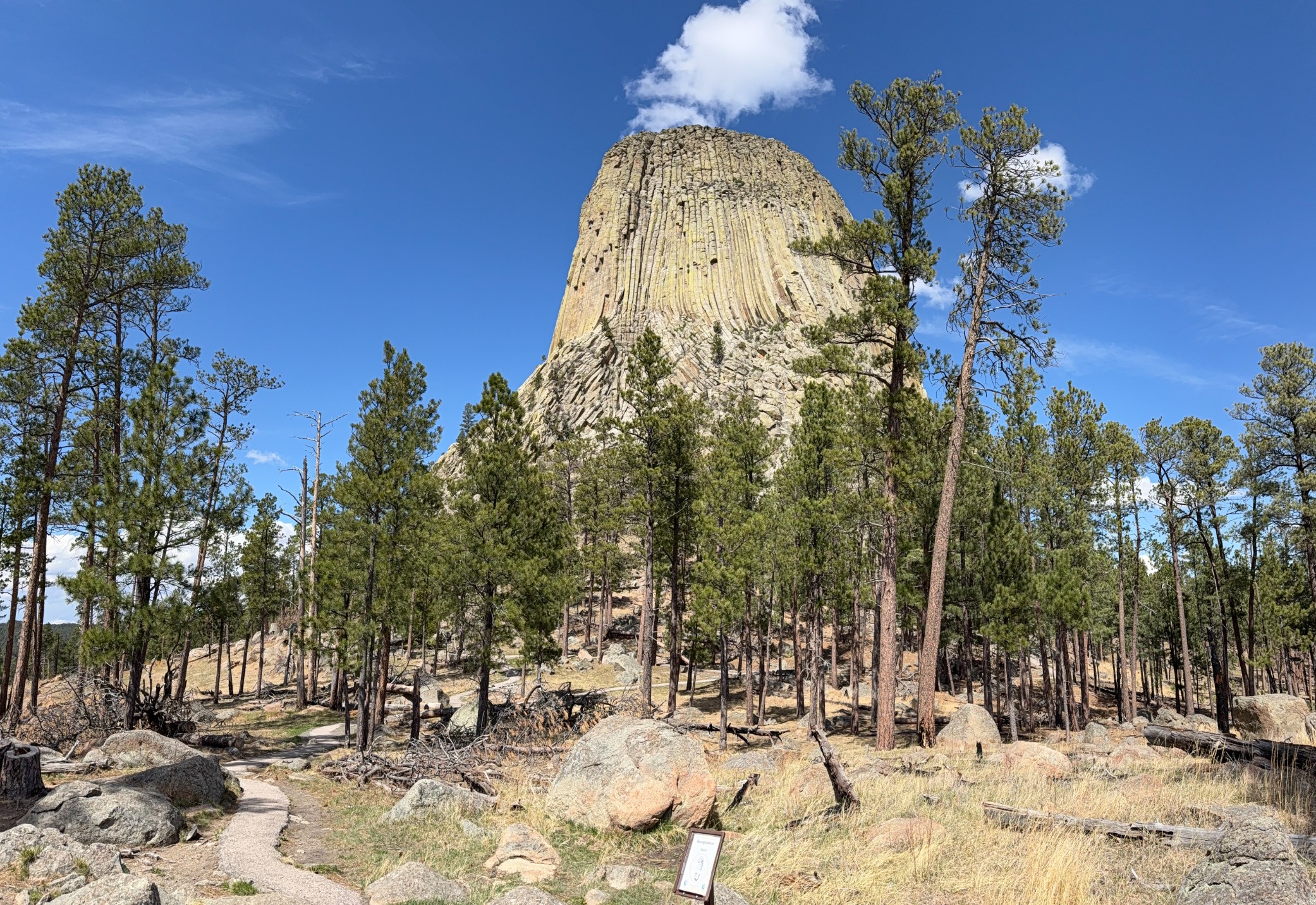
Mato Tipila rises suddenly from the Wyoming plains. Its columns can be seen for miles, yet no photograph prepares you for standing beneath them.
The story held here
Six Weeping Sisters and the Pleiades.
Story tradition · Kiowa
To many Native nations — Lakota, Cheyenne, Kiowa, Crow, and others — it is held in ceremony, story, and relationship that long predate the United States. One Kiowa account tells of girls pursued by bears who climbed onto a rock for safety. The rock rose beneath them until the bears could no longer reach them; their claws left the great vertical marks that remain on the Tower. The girls were carried into the sky, becoming the Pleiades. Other Nations hold distinct accounts, and none are ours to collapse into a single story.
A question the stories open
Krittika and the self-arisen stone.
Vedic contemplative lens
Through a Vedic lens, the girls' ascent to the Pleiades stirred the story of Krittika: the six celestial mothers who nurture the infant Kartikeya. The rock rising from the earth also brought to mind a svayambhu Shiva lingam—a naturally self-manifested form, revered as one in which Shiva is already alive rather than made or installed by human hands.
The traditions are their own; yet the affinity is difficult to dismiss. Across continents, a rock rises of its own accord, girls become the same cluster of stars, and the landscape is understood to hold more than its visible form. It left us with a question, not an answer: how can cultures separated by such distance hold stories that mirror one another so closely? Perhaps the boundaries on our modern maps do not tell the whole story of how human beings once moved, remembered, and encountered the sacred.
How we came to the Tower
Sun Dance ceremonies were traditionally held at the Tower around the summer solstice, and contemporary ceremonies continue there today: a living tradition rooted in sacrifice, courage, prayer, and renewal. We didn't go there to recreate anyone else's practice. We went to sit in humility before a site that has held prayer for generations, and to ask what renewal might require of us in our own lives.
The Tower did not ask us to do more. It asked us to become still enough to meet it. By day, Mato Tipila is seen from every angle—photographed, climbed, explained, and passed through. But its deeper invitation felt different: to remain after the activity had receded, when there was nothing left to take from it. That is why we chose to be there at midnight.
Why we chose to be there at midnight
When the activity falls away, presence has room to arrive.
In Vedic tradition, the moon is deeply associated with Shiva. In many depictions, Chandra—the moon—is held in Shiva's matted hair. It represents the mind: its changing moods, its waxing and waning, and its capacity to reflect light.
Shiva wears the moon because consciousness is greater than the mind. He does not reject its cycles; he holds them. At the full moon, the mind's reflective capacity is at its peak—clear enough to receive, quiet enough to reflect, and held by the presence of Shiva.
That night was especially significant. The full-moon tithi had begun on the evening of July 28 and carried into Guru Purnima on July 29—the annual full moon dedicated to the guru, the one who leads a person from confusion toward clear seeing. It is also known as Vyasa Purnima, honoring Vyasa, the sage traditionally associated with preserving and transmitting so much of Vedic spiritual wisdom.
So we sat at the base of Mato Tipila within a convergence: a powerful landscape, a night of full lunar force, and a day devoted to the transmission of wisdom. From roughly 11:30 p.m. to 1:30 a.m., the ordinary activity of the monument had receded. There were no cameras to accommodate, no itinerary to follow, no ceremony to perform, and no expectation that anyone needed to have a breakthrough. The Tower stood in silhouette. The moonlight moved through the clouds. The seven of us simply sat.
The place seemed to exude the kind of stillness that makes meditation possible even for someone who has never practiced before. Not because meditation was being imposed on anyone, but because the usual reasons the mind keeps moving had nowhere to go.
Medicine Wheel
Find the center before taking the next step.
High in the Bighorn Mountains, the Medicine Wheel is a circle of stone: a center, an outer rim, and spokes reaching in every direction. For Indigenous peoples, it is a living ceremonial landscape. We entered as guests, with reverence for a meaning that neither begins nor ends with us.
Vedic cosmology · Patala, Vamana & Sudarshana
Earlier in the journey, Vedic resonances emerged as questions: a rising stone, the Pleiades, and a form understood as self-arisen. At the Medicine Wheel, those questions resolved into a conviction within Heramba's Vedic reading of this land.
A Vedic lens
Patala: a sacred realm
At the Wheel, we found ourselves asking how its circle, center, and spokes might be held within the Vedic cosmology we carry. The answer that emerged for us was Patala—not as a label for this Indigenous place, but as a contemplative way of naming the resonance we felt in the land.
In Vedic thought, Patala is a vast realm within the map of the cosmos. It is often casually translated as an underworld or hell, but the ancient texts describe something very different: a place of immense beauty, wealth, power, and spiritual force.
In the Vishnu Purana, the wandering sage Narada travels to Patala and returns to the celestial world with a startling observation: it was more delightful than Indra's heaven. Indra is the king of the gods in the heavenly realm; Narada's point is clear. Patala was a radiant world in its own right.
The promise
Vamana and Mahabali
That description becomes important in the story of Vamana, an incarnation of Vishnu. Vishnu is the divine preserver: the force in Vedic thought that protects balance and restores order when it has been disturbed. In the story, he appears in the humble form of a young seeker and approaches Mahabali, a powerful, generous king. Vamana asks Mahabali for only three steps of land. When Mahabali agrees, Vamana expands into his cosmic form: with one step he encompasses the earth; with the second, the heavens. For the third step, Mahabali offers his own head.
Vishnu honors his surrender and grants him sovereignty in Sutala, a realm within Patala. More importantly, Vishnu promises to remain there as Mahabali's protector. Patala is not abandoned. It is entrusted—and guarded.
The image we carried
Sudarshana: auspicious seeing.
At the Medicine Wheel, Vishnu's promise takes visible form. The wheel—with its central hub, circular boundary, and spokes extending toward every direction—stands as the Sudarshana Chakra, Vishnu's sacred wheel or discus. Sudarshana means “right” or “auspicious” seeing. It is traditionally shown in Vishnu's hand as a force that protects sacred order: cutting through confusion, restoring balance, and guarding what has been entrusted to his care.
Within that Vedic reading, the Medicine Wheel became an enduring sign of that guardianship: Vishnu's chakra present in the land of Patala, holding the directions and keeping watch.
Why this isn't something you can replicate
The journey is more than the route.
You can visit these four places on your own. We hope you do, with the same reverence we tried to bring. But visiting the places was never the offer.
What isn't on any map
Careful timing
A journey deliberately timed around Guru Purnima, when our midnight meditation at the Tower could be held within a tradition devoted to the transmission of wisdom.
A held encounter
A facilitator who has spent years under a Vedic teacher—not learning what these places mean, but learning how to help another person encounter their own meaning without performing an answer for them.
Heather had considered doing this herself: camping, taking two weeks, and building a solo itinerary across unfamiliar terrain and sacred sites. What she found instead was four days, a group that arrived for the same reason she did, and someone who had already done the work of reading the calendar and shaping the route so she could simply be present.
“It would have been more expensive to do it on my own. Everything would have been… logistically much more involved and required more of me. To see Standing Rock, Mato Tipila, and Medicine Wheel in a four-day trip is not something that I could have managed on my own.”
What the journey made possible
No two people met these places in the same way.
That was part of the point. These reflections are shared with permission from the people who traveled with us.
I felt like Mato Tipila was a mirror — showing me how I was showing up, and asking me if that's how I want to show up, or if there's a different way I'd like to grow.
— Heather H.
What you are actually joining
More than an itinerary.
A Heramba Journey is a small, carefully held pilgrimage for people who want to step out of the speed of ordinary life and enter a deeper relationship with place, silence, and themselves.
We travel in intimate groups. We prepare before arriving, reflect together at each site, leave room for solitude and meditation, and make time each evening to name what the day has stirred.